Octy Kitchen Utensils Holder: Two Smart Versions
Imagine a kitchen counter that doesn't just hold your tools but actually interacts with them. Enter the Octy Kitchen Utensils Holder 2 Versions, a charming and highly functional 3D printed design that transforms a mundane storage problem into a delightful display of creativity. Designed by Sigma Designers, this project features an eight-limbed friend ready to organize your culinary workspace. Whether you are a hobbyist looking for your next print, a small business owner seeking unique products to sell, or a designer exploring modular utility, Octy offers a perfect blend of whimsy and practical engineering.
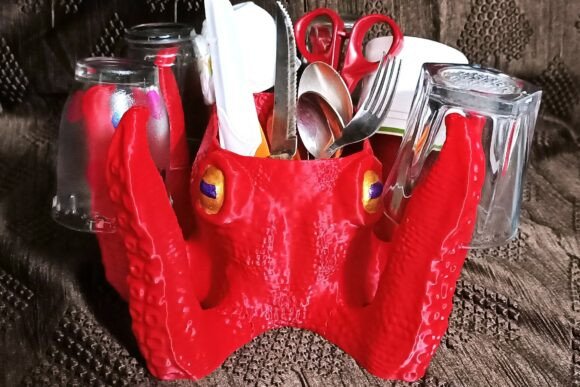
The core concept is simple yet brilliant: an octopus figure where the eight limbs serve as holders for larger items like chopping boards, glasses, and cups, while the head is designed to store smaller utensils such as spoons, forks, and knives. What makes this model particularly interesting for the maker community is its availability in two distinct versions, each catering to different organizational needs and aesthetic preferences. This flexibility allows users to adapt the design to their specific kitchen layout or customer demands without needing to modify the base geometry themselves.
Choosing Between the Two Versions
The true strength of the Octy Kitchen Utensils Holder 2 Versions lies in the thoughtful distinction between the two available models. Understanding which version suits your project is the first step toward a successful print.
Version 1: The Open Creative Space
The first version features a head with free, open space. This design is ideal for those who prefer a minimalist look or who need to store irregularly shaped items that don't fit into standard compartments. It offers maximum versatility; you can toss in a mix of whisks, spatulas, and tongs without worrying about alignment. For artists and customizers, this open cavity provides a blank canvas. You can easily insert custom 3D printed dividers later if your needs change, or simply leave it open for quick access. It is the "grab-and-go" option for busy kitchens where speed matters more than strict categorization.
Version 2: The Organized Separator
For the neat freaks and professional organizers, Version 2 includes built-in separations within the head. These internal walls prevent utensils from tangling together, ensuring that your forks stay with your forks and your spoons remain accessible. This version is particularly valuable for commercial settings, such as coffee shops or food trucks, where hygiene and rapid retrieval are critical. By avoiding the mixing of utensils, this model promotes a cleaner workflow. If you are selling these holders, Version 2 often appeals more to customers looking for a premium, organized solution for their countertops.
Technical Specifications for Optimal Printing
To bring Octy to life with the best possible quality, adhering to the recommended printing settings is essential. The design is optimized for both FDM (Fused Deposition Modeling) and Resin printers, making it accessible to a wide range of makers. However, the material choice is paramount since this item will come into direct contact with food and drink.
- Filament Selection: Always use non-toxic materials. PLA is a popular choice for its ease of printing and vibrant color options, but ensure it is food-safe certified if you plan to use it for holding drinks. PETG is another excellent option, offering higher heat resistance and durability, which is crucial if the holder sits near a stove or holds hot cups. For resin users, selecting a non-toxic, food-safe resin is mandatory to avoid chemical leaching.
- Line Width: A line width of 0.5mm is recommended. This slightly wider extrusion helps create stronger layer adhesion and reduces print time while maintaining the fine details of Octy's facial features and limb textures.
- Infill: You have significant flexibility here, with settings ranging from 0% to 5%. Since the structural integrity comes largely from the outer shells and the thick limbs, high infill is unnecessary. Keeping infill low saves material and reduces print time without compromising stability.
- Supports and Adhesion: One of the most user-friendly aspects of this design is that supports are generally not necessary. The geometry is self-supporting, which means less post-processing time and no risk of support scars on visible surfaces. Similarly, build plate adhesion usually requires no special measures. However, if your printer bed has minor leveling issues, a simple 5mm brim can ensure the base stays firmly planted during the initial layers.
Creative Applications and Business Opportunities
The Octy Kitchen Utensils Holder 2 Versions is more than just a household item; it is a versatile asset for creators and entrepreneurs. The licensing terms provided by Sigma Designers are notably creator-friendly: you are permitted to print and sell the physical model, opening immediate avenues for small business revenue. However, sharing or selling the digital files themselves is prohibited, protecting the intellectual property of the original designers while allowing you to profit from your manufacturing efforts.
Consider the potential for multi-color printing. Since the model is available via .3mf files, which often contain color data, you can leverage multi-extruder printers or pause-and-swap techniques to create stunning visual effects. Imagine an Octy with blue limbs and a yellow head, or perhaps a gradient effect that mimics real marine life. These aesthetic variations can command higher price points on platforms like Etsy or at local craft fairs.
Educators and workshop leaders can also utilize this project to teach principles of functional design and material safety. It serves as an excellent case study for discussing why certain geometries require no supports and how infill density affects object strength. For interior designers, Octy offers a way to inject personality into sterile kitchen environments, proving that organization tools don't have to be boring plastic bins.
Maintaining Quality and Consistency
When producing these holders, whether for personal use or for sale, consistency is key. Because the limbs are designed to hold weight (like heavy chopping boards or full glasses), ensure your first layer is perfectly squished to guarantee strong bed adhesion. If you are using FDM, orient the part so that the layer lines run vertically along the limbs; this prevents splitting under lateral stress. For resin prints, thorough washing and curing are vital to ensure no residue remains on the surface, especially given the food-contact application.
Customization is another avenue for adding value. While the base model is complete, you can experiment with surface textures or add magnetic bases to keep Octy fixed to metal countertops. Just remember to maintain the structural integrity of the limbs and the head compartments. The goal is to enhance the utility, not compromise it.
In a world of mass-produced kitchenware, the Octy Kitchen Utensils Holder 2 Versions stands out as a testament to what community-driven design can achieve. It solves a real problem with a smile, offers flexible options for different users, and provides a clear path for creators to engage with the market. Whether you choose the open freedom of Version 1 or the structured order of Version 2, printing Octy is an invitation to make your kitchen a little more organized and a lot more fun.
So, load up your filament, check your nozzle temperature, and get ready to meet your new eight-limbed assistant. Thank you for exploring this creative project, and from all of us at Sigma Designers: Have an Octy day!