Evaluating the Gingerbread Baker Card SVG for Professional Holiday Crafting
The holiday season often demands a balance between efficiency and personalization, particularly for creators, small business owners, and educators who need to produce high-quality greetings without sacrificing time. The Gingerbread Baker Card SVG emerges as a compelling solution in this space, offering a structured yet flexible approach to creating interactive 3D paper crafts. Unlike standard flat cards, this digital asset provides the blueprint for a dimensional scene that transforms a simple greeting into a display piece. For professionals evaluating creative assets, the value lies not just in the aesthetic appeal, but in the engineering behind the cut files and their adaptability across various production workflows.
Engineering and Structural Design
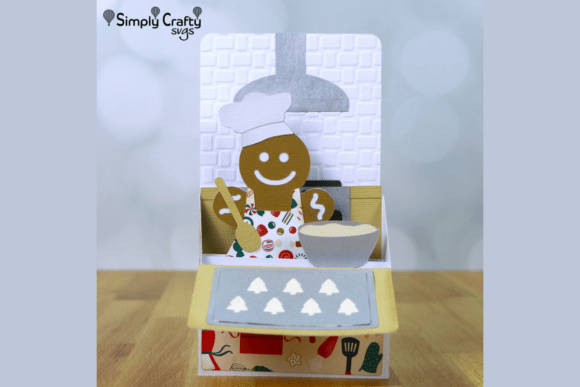
At its core, the Gingerbread Baker Card SVG is designed to solve a common logistical problem in paper crafting: how to create a robust 3D structure that remains mail-friendly. The design features a pop-up mechanism that reveals a cozy holiday kitchen scene centered around a gingerbread man baker. What makes this technically impressive is its ability to fold completely flat. This engineering ensures that despite the dimensional complexity when opened, the card fits within standard shipping constraints.
When flattened, the card measures 5″ x 7″, aligning perfectly with the industry-standard A7 envelope size. This compatibility is crucial for anyone sending these cards in bulk or through professional mailing services, as it eliminates the need for custom packaging or extra postage due to irregular thickness. The structural integrity relies on precise scoring and folding lines embedded within the SVG data. For users operating cutting machines like Cricut or Silhouette, this precision translates to cleaner folds and a more reliable pop-up action, reducing the failure rate often associated with complex paper engineering.
Material Selection and Aesthetic Execution
The visual impact of the final product is heavily dependent on material choices, and the Gingerbread Baker Card SVG is optimized for specific paper weights and textures. The design recommends using one 12″ x 12″ sheet of cardstock for the primary red elements, which typically form the structural base or the "oven" backdrop. For the remaining components, smaller scraps suffice, making this an excellent project for utilizing offcuts and minimizing waste—a key consideration for cost-conscious entrepreneurs and eco-aware creators.
To achieve the intended "royal icing" effect on the gingerbread characters, the design encourages the use of varying shades of brown and white cardstock. Professionals might elevate this further by incorporating metallic papers or textured stocks, such as the American Crafts AC Textured Cardstock mentioned in the assembly guidelines. These materials add depth and tactile quality that standard printer paper cannot replicate. The layering capability inherent in SVG files allows crafters to separate elements like the baker's hat, apron, and facial features, enabling a level of detail that mimics hand-drawn illustration when assembled correctly.
Workflow Efficiency and Usability
For freelancers and marketers managing tight deadlines during the fourth quarter, workflow efficiency is paramount. The Gingerbread Baker Card SVG addresses this by offering letter-size compatible dimensions when ungrouped, ensuring seamless integration into most design software interfaces. The inclusion of a step-by-step video tutorial significantly lowers the barrier to entry. Even for those with limited experience in 3D papercraft, the visual guidance reduces the learning curve, allowing for consistent results across multiple units.
The file structure itself supports flexibility. Because the elements are vector-based, they can be resized or modified slightly to fit specific branding needs without losing resolution. A small business owner could potentially add a logo to the baker's apron or adjust the color palette to match corporate branding before cutting. However, it is important to note that altering the structural score lines requires a deep understanding of paper engineering; thus, while cosmetic changes are encouraged, structural modifications should be approached with caution to maintain the card's ability to fold flat.
Practical Applications Across Industries
The versatility of the Gingerbread Baker Card SVG extends beyond personal hobby use. Several professional demographics can leverage this asset effectively:
- Educators and School Administrators: The clear assembly steps make this an ideal STEM or art project for older students, teaching principles of geometry, spatial reasoning, and following technical instructions.
- Small Business Owners: Retailers in the baking or culinary sector can use these as premium thank-you notes for clients, reinforcing their brand identity through the "baker" theme while providing a memorable physical touchpoint.
- Content Creators and Bloggers: The visual nature of the finished card provides excellent content opportunities for social media tutorials, holiday gift guides, or DIY blog posts, driving engagement through high-quality imagery.
- Event Planners: For holiday parties or corporate events, these cards can serve as unique invitations or table place cards that double as favors, adding a interactive element to the guest experience.
Quality Consistency and Long-Term Value
When investing in digital assets, reliability is a primary concern. The Gingerbread Baker Card SVG demonstrates strong consistency in its output. Because the cutting paths are predefined, the variance between the first card produced and the hundredth is minimal, assuming consistent machine calibration and material usage. This repeatability is essential for anyone producing batches for sale or distribution.
Furthermore, the long-term value of this file lies in its reusability. Unlike a physical template that wears out or gets lost, the SVG file remains a permanent part of the creator's library. It can be revisited annually, with variations in paper choice keeping the design fresh year after year. The durability of the final product also adds value; constructed from heavy cardstock, these cards are sturdy enough to be displayed on mantles or tables throughout the season, extending the lifespan of the greeting well beyond the initial exchange.
Limitations and Considerations
While the Gingerbread Baker Card SVG offers significant advantages, potential users should be aware of certain limitations. The assembly process, though aided by a tutorial, is time-intensive compared to printing a flat card. Each unit requires gluing, folding, and tab insertion, which may not be feasible for extremely large-scale campaigns without dedicated labor. Additionally, the 3D nature, while flattenable, still requires careful handling during the mailing process to ensure the internal mechanisms do not snag or tear the envelope if not inserted correctly.
Users must also have access to a compatible electronic cutting machine to fully realize the design's potential. While manual cutting is theoretically possible, the intricacy of the small tabs and score lines makes it impractical for hand-cutting, limiting the audience to those with specific hardware investments.
Final Assessment
In conclusion, the Gingerbread Baker Card SVG represents a high-quality resource for adults seeking to elevate their holiday communications. It successfully bridges the gap between whimsical design and functional engineering. Its strength lies in the thoughtful balance of interactive storytelling and practical mailing specifications. For professionals who value distinctiveness and are willing to invest time in assembly, this asset delivers a tangible return in the form of memorable, shareable, and durable holiday greetings. Whether used for client appreciation, educational purposes, or personal expression, it stands as a reliable tool in the modern crafter's arsenal.