Elevating Event Styling with a Kawaii Drip Cake Stand STL Dessert Display
In the evolving landscape of event planning and home aesthetics, the intersection of digital fabrication and culinary presentation has opened new avenues for creativity. Central to this movement is the Drip Cake Stand STL Dessert Display, a 3D printable model that merges functional utility with the whimsical charm of kawaii culture. For professionals in the hospitality industry, hobbyist makers, and content creators alike, understanding the nuances of this design offers more than just a way to hold a cake; it provides a gateway to customizing physical spaces with unique, on-demand decor that stands out in an era of mass-produced party supplies.
The concept of the "drip" in cake decoration is iconic, representing richness and indulgence. Translating this visual motif into a structural object via additive manufacturing requires a keen eye for geometry and stability. The resulting product is not merely a prop but a statement piece that bridges the gap between digital design files and tangible celebration elements. By exploring the characteristics, printing considerations, and diverse applications of this specific STL file, users can maximize its potential across various settings, from intimate birthday gatherings to professional photo shoots.
The Aesthetic Appeal of Chubby Geometry and Smooth Surfaces
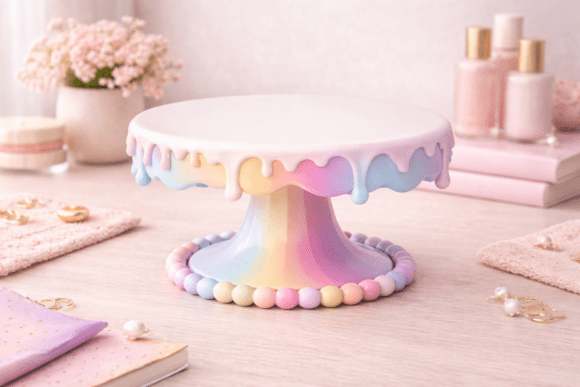
The defining characteristic of this particular dessert display is its adherence to the kawaii aesthetic, which prioritizes cuteness through soft, rounded, and often "chubby" proportions. Unlike traditional cake stands that rely on sharp angles, intricate filigree, or minimalist straight lines, this design embraces volume and curvature. The bold dripping icing effect is not just a surface texture but an integral part of the stand's silhouette, creating a sense of motion and fluidity even when the object is stationary.
From a design theory perspective, the success of such a model lies in its clean geometry. For a 3D print to look professional rather than amateurish, the transition between the pedestal base and the plate must be seamless. The "smooth, rounded cake plate" mentioned in the design specifications serves a dual purpose: it enhances the visual appeal by eliminating harsh edges that could distract from the food displayed, and it simplifies the post-processing workflow for the printer. When light hits these curved surfaces, it creates soft gradients rather than sharp reflections, contributing to the "clean aesthetic" that is highly sought after for modern interior styling and social media content creation.
Furthermore, the thick walls associated with this design are not arbitrary. They contribute to the visual weight of the object, making it appear substantial and high-quality. In the context of photography, where depth and texture are paramount, the chubby shapes provide excellent opportunities for shadow play, adding dimensionality to flat-lay images or table setting compositions.
Technical Considerations for Reliable 3D Printing
While the visual outcome is paramount, the practicality of producing the Drip Cake Stand STL Dessert Display relies heavily on its engineering for additive manufacturing. A common pitfall in downloading free or paid STL files is encountering models that look great on screen but fail during the printing process due to overhangs, thin walls, or unstable bases. This specific model addresses those concerns by being explicitly "designed with 3D printing in mind."
The "strong, stable base" is a critical feature. In Fused Deposition Modeling (FDM) printing, the first few layers determine the success of the entire print. A wide, sturdy footprint ensures that the stand does not warp or detach from the build plate, even when printing taller variations or using materials with higher shrinkage rates like ABS. For users utilizing resin printers (SLA/DLP), the solid geometry minimizes the risk of layer separation under the weight of the cake plate.
Moreover, the description highlights a "beginner-friendly print." This suggests that the model likely avoids complex support structures that are difficult to remove without damaging the delicate drip details. In many drip-themed designs, the hanging icing requires supports. However, a well-optimized file will angle these drips or thicken them sufficiently to be self-supporting up to a certain degree, reducing material waste and sanding time. The emphasis on "smooth surfaces" implies that the layer height recommendations for this file are optimized to minimize visible stepping, ensuring that the final product feels as good as it looks.
Material Selection and Food Safety Protocols
A crucial consideration for any creator intending to use this stand for actual food service is material safety. While the STL file provides the shape, the user must select the appropriate filament or resin. Standard PLA (Polylactic Acid) is biodegradable and derived from renewable resources, making it a popular choice for its ease of printing and smooth finish. However, standard PLA is not inherently food safe due to the microscopic gaps between layers where bacteria can thrive, and some filaments contain additives that are not certified for food contact.
For professional bakers or those serving guests, it is imperative to either use a food-safe certified filament and seal the print with a food-grade epoxy coating or to use the stand as a decorative riser with a barrier. Many creators opt to place a cardboard doily or a glass plate on top of the 3D printed stand, using the Drip Cake Stand STL Dessert Display purely for its visual elevation and style while maintaining strict hygiene standards. This hybrid approach allows for the aesthetic benefits of 3D printing without compromising health regulations.
Versatile Applications Beyond the Birthday Party
Although the primary association for a cake stand is a birthday celebration, the versatility of this kawaii design extends far beyond annual milestones. The unique character of the drip motif makes it a powerful tool for branding and thematic consistency in various commercial and personal contexts.
- Retail and Bakery Displays: Boutique bakeries can use these stands to highlight signature items like cupcakes or macarons. The distinct look reinforces a brand identity that values creativity and modern trends.
- Content Creation and Photography: Influencers and photographers constantly seek fresh props. The "aesthetic content photos" potential of this stand is significant. Its neutral yet stylized appearance complements pastel color palettes often found in lifestyle blogging, unboxing videos, and product showcases.
- Educational Workshops: For educators teaching STEM or art classes, this file serves as an excellent case study. It demonstrates how digital modeling translates to physical objects, allowing students to explore concepts of balance, center of gravity, and surface topology.
- Home Decor: Even without a party, the stand functions as a sculptural element in a kitchen or dining room. It can hold non-food items like jewelry, keys, or small plants, acting as a conversation starter that reflects the homeowner's interest in technology and design.
Customization and Color Theory
One of the most compelling advantages of owning the STL file rather than buying a finished product is the ability to customize color. In traditional manufacturing, changing the color of a product often requires a new mold or a painting process. With 3D printing, a user can switch filaments instantly. This allows for perfect color matching with event themes. Imagine a baby shower where the stand is printed in a soft mint green to match the napkins, or a Halloween party where the "drip" is printed in a contrasting orange against a black base.
Advanced users might even experiment with multi-material printing or gradient effects, although this requires more sophisticated hardware. The "clean geometry" of the model ensures that whatever color is chosen, the light interacts with the form consistently, preserving the intended cute and chubby vibe regardless of the hue.
The Economic and Environmental Impact of Digital Fabrication
Adopting the Drip Cake Stand STL Dessert Display also touches upon broader economic and environmental themes relevant to business owners and conscious consumers. The shift towards digital inventory—where designs are stored as files and printed on demand—reduces the need for warehousing physical stock. For small business owners selling party supplies or decor, this means lower overhead costs and the ability to offer a wider variety of designs without financial risk.
Environmentally, 3D printing can be more sustainable than injection molding for low-volume production because it is an additive process; material is only deposited where needed, generating less waste than subtractive methods. Furthermore, if a stand breaks or becomes outdated, it can potentially be ground down and recycled into new filament, closing the loop on the product lifecycle. This aligns with the growing consumer demand for sustainable practices in the events and hospitality industries.
Integration into Professional Workflows
For event planners and stylists, integrating 3D printed assets into their workflow requires a shift in mindset. It moves the timeline of procurement earlier, as printing takes time. However, the payoff is exclusivity. In a market saturated with identical plasticware and generic decorations, offering a client a bespoke, 3D printed centerpiece demonstrates a high level of attention to detail and innovation. The reliability of the print, ensured by the model's "thick walls" and "stable base," means that professionals can trust these items to perform during high-stakes events without failure.
Additionally, the file acts as a long-term asset. Once downloaded, the Drip Cake Stand STL Dessert Display is available indefinitely. If a stand is damaged or a client requests multiple units for a large wedding, the creator can simply print more. This scalability is invaluable for businesses that experience fluctuating demand.
Conclusion on Design Utility
The convergence of kawaii aesthetics and functional engineering in this dessert display represents a microcosm of the broader maker movement. It proves that digital tools can produce objects that are emotionally resonant, visually striking, and practically useful. Whether utilized for a child's birthday, a professional photoshoot, or as a piece of eclectic home decor, the stand offers a unique blend of charm and utility. By understanding the technical strengths of the design—such as its printability and structural integrity—and leveraging its aesthetic flexibility, users can transform simple gatherings into memorable experiences. The Drip Cake Stand STL Dessert Display is not just a file; it is a versatile tool for creativity that empowers individuals to take control of their physical environment, one layer at a time.